Unveiling Hidden Marvels and Historical Monuments Between Agra and Jaipur
Why You Should Slow Down Between Agra and Jaipur
Most first-time visitors to India race between Agra and Jaipur as if the only goal is to tick the Taj Mahal and the Pink City off a list. The highway is treated like a simple transfer, a necessary stretch of road between two icons of the Golden Triangle. Yet tucked just off this route lies a chain of stepwells, forts, villages, bird sanctuaries and temples that quietly tell the deeper story of North India’s past and present. Turning this “travel day” into a sightseeing day can change the entire feel of your trip.
On this stretch you can wander through a once-imperial Mughal capital, stand at the edge of one of the world’s most dramatic stepwells, walk inside a fort wrapped in ghost stories, share chai with villagers in timeless rural Rajasthan, glide through a bird-filled wetland and track tigers across a rugged landscape of lakes and hills. These places are not as busy as the major cities, which means more time to talk to locals, experiment with photography and soak up atmosphere without constant crowds.
This guide brings together the most rewarding stops between Agra and Jaipur and helps you fit them into a realistic route. You will find history and background, reasons to include each place, ticket prices and distances, suggested day plans and practical tips. Treat the road as part of the adventure, not just the gap between destinations, and your Golden Triangle journey turns from a checklist into a far richer story.
Historical and Cultural Context of the Agra–Jaipur Corridor
The landscape between Agra and Jaipur has been shaped for centuries by empires, trade routes and pilgrimage paths. Agra was once the Mughal seat of power; Jaipur grew into a planned capital of the Rajput rulers of Amber. The road between them naturally filled with fortified waystations, temple towns and watering points that supported caravans, armies and pilgrims. Many of the places you can visit today began as practical stops: stepwells to store precious water, forts to guard passes, villages at crossroads and shrines in scenic or sacred locations.
Fatehpur Sikri, for instance, was built by Emperor Akbar as a statement of power and faith, combining Persian, Indian and Central Asian ideas in one planned capital. Abhaneri’s Chand Baori stepwell reveals the engineering brilliance of early medieval Rajasthan, where every drop of water mattered. Bhangarh Fort and its abandoned town evoke frontier politics and later legends of curses. Rural pockets like Rusirani preserve older rhythms of life, while Bharatpur’s Keoladeo wetlands show how royal hunting grounds evolved into modern wildlife sanctuaries. Ranthambore adds a layer of Rajput resilience and conservation, and Galtaji Temple near Jaipur weaves spiritual practice into a dramatic rocky setting.
Top Reasons to Explore Between Agra and Jaipur
- See more than just cities: Combining forts, stepwells, villages and nature reserves breaks up an otherwise urban-heavy itinerary and gives a more balanced impression of North India.
- Use your transfer day efficiently: Instead of “losing” a day to travel, you can turn the Agra–Jaipur drive into a full day of sightseeing with one or two carefully chosen stops.
- Experience smaller crowds and slower pace: Places like Abhaneri, Rusirani Village and Galtaji Temple usually feel calmer than big-ticket monuments, which means more space and better photo opportunities.
- Deepen your understanding of history: Visiting multiple sites from different eras – Mughal, Rajput, village and colonial – helps you connect the dots between India’s many historical layers.
- Add wildlife and nature to your Golden Triangle: Bharatpur’s bird sanctuary and Ranthambore’s tiger reserve bring you face to face with India’s wild side without requiring long detours.
Key Stops Between Agra and Jaipur
Fatehpur Sikri: Akbar’s Red Sandstone Capital

Fatehpur Sikri, just west of Agra, is one of the most striking examples of Mughal architecture anywhere in India. Built in the 16th century by Emperor Akbar, it functioned as the imperial capital for around fifteen years before being largely abandoned, likely due to water issues and shifting political needs. Today, the complex stands as an almost frozen snapshot of courtly life, blending Persian-influenced design with local craftsmanship.
Inside the fortified walls you can wander through grand courtyards, audience halls and palaces, each with its own carvings and layout. The enormous Buland Darwaza – the “Gate of Magnificence” – looms over the landscape and is counted among the highest gateways in the world. Nearby, Jama Masjid ranks as one of India’s great mosques, while the marble Tomb of Salim Chishti remains an active pilgrimage site where visitors quietly tie threads and make wishes. For many travellers, Fatehpur Sikri is the single most rewarding stop on the road between Agra and Jaipur.
Typical ticket price: around ₹35 for Indian visitors and ₹550 for foreign nationals (check current rates before travel).
Camera: generally allowed in most outdoor areas, with restrictions inside some shrines.
Approximate distance from Agra: about 35–40 km.
Abhaneri and Chand Baori: Rajasthan’s Geometric Stepwell

Abhaneri is a small village that hides one of India’s most extraordinary stepwells: Chand Baori. At first glance it looks like an impossible geometric sketch brought to life – more than three thousand narrow steps descend in precise, repeated patterns down three sides of a deep pit, while a pavilion of balconies and small chambers sits on the fourth side. Built between the 8th and 9th centuries, Chand Baori functioned both as a vital water reservoir and a cool retreat from the harsh desert heat.
Standing at the edge, you can appreciate how ingeniously the builders used symmetry and depth to protect water from evaporation. The scale surprises almost everyone who visits, especially because the village around it remains quiet and unassuming. A short walk away, the Harshat Mata Temple adds another layer of history and devotion, with sculptural fragments hinting at the site’s former glory. Abhaneri fits easily into a transfer day itinerary and gives you photographs and memories very different from the usual palace and fort shots.
Typical ticket price: around ₹40 for Indian visitors and ₹200 for foreign nationals.
Camera: allowed, and highly recommended for stepwell photography.
Approximate distance from Jaipur: roughly 90 km, just off the main highway.
Bhangarh Fort: Ruined Palaces and Famous Legends

Bhangarh Fort, in the Alwar district, is often introduced as “one of the most haunted places in India,” but even without the ghost stories it would be worth a visit. The ruined complex sits in a scenic bowl of low hills, with old gateways, marketplaces, havelis and palace remains spread across a broad slope. Built in the 16th century for Madho Singh, the fort once anchored a lively township that has since fallen into silence, leaving behind evocative stone arches and empty courtyards.
Visitors enter through a succession of gates and wander up through the remnants of bazaars and temples towards the main fort area. The atmosphere changes noticeably as you climb, with fewer people and wider views across the surrounding countryside. Local tales speak of curses and restless spirits, and while official rules focus more on safety than superstition, there is a reason authorities do not allow people to stay after dark. Whether or not you are interested in paranormal stories, Bhangarh offers dramatic photography, an unusual stop between Jaipur and Sariska or Alwar, and a vivid sense of how quickly towns can rise and fall.
Typical ticket price: around ₹25 for Indian visitors and ₹200 for foreign nationals.
Camera: allowed in most areas.
Approximate distance from Jaipur: about 80–85 km, usually combined with other nearby sites in a day trip.
Rusirani Village: Living Traditions in Rural Rajasthan

While palaces and forts tell the story of rulers, villages like Rusirani show how most people in Rajasthan have lived for generations. Set in rural countryside a comfortable drive from Agra, this settlement offers travellers a chance to move at village pace: people greeting each other in narrow lanes, children walking to school, farmers tending fields and potters or artisans at work. Instead of grand corridors of stone, the highlights here are kitchen courtyards, local temples and the conversations you have along the way.
Many curated visits to Rusirani include a mix of off-road driving, guided walks, stops at small shrines and temples – some of which locals link to Mahabharata-era stories – and a home-style meal cooked over traditional stoves. Sitting down to simple Rajasthani dishes made with local ingredients can be a refreshing change from restaurant buffets and hotel menus. For travellers who want to understand the human side of the Golden Triangle rather than just its monuments, a few hours in a village like Rusirani can become one of the most memorable parts of the journey.
Typical ticket/visit cost: usually included as part of a village tour package rather than a separate monument ticket.
Camera: generally allowed, but always ask before photographing people or private homes.
Approximate distance from Agra: around 70 km, depending on the exact route.
Bharatpur and Keoladeo National Park: Wetlands and Birdlife

Bharatpur, in eastern Rajasthan, is best known for Keoladeo National Park, a UNESCO-listed bird sanctuary that transforms with the seasons. What used to be a royal duck-hunting reserve is now one of India’s most important wetland habitats, drawing more than three hundred species of resident and migratory birds each year. During peak months, shallow lakes and marshes fill with pelicans, storks, herons, egrets, ducks, geese and – in good years – even rarer visitors from Central Asia.
One of the most charming ways to explore the park is by cycle rickshaw. Local rickshaw pullers often double up as spotters, pointing out camouflaged birds in reeds or high branches and knowing exactly where certain species like to feed. Quietly moving along the paths, you might also glimpse animals such as deer, wild boar and, deeper in the park, more elusive creatures. Once back in town, Bharatpur’s own forts, palaces and temples provide an architectural counterpoint to the natural scenery inside the sanctuary.
Typical ticket price: roughly ₹75 for Indian visitors and ₹500 for foreign nationals, with extra fees for vehicles and some equipment.
Camera: allowed; telephoto lenses are very useful here.
Approximate distance from Jaipur: about 180–190 km; from Agra, around 55 km.
Ranthambore National Park: Tigers and Ruined Ramparts
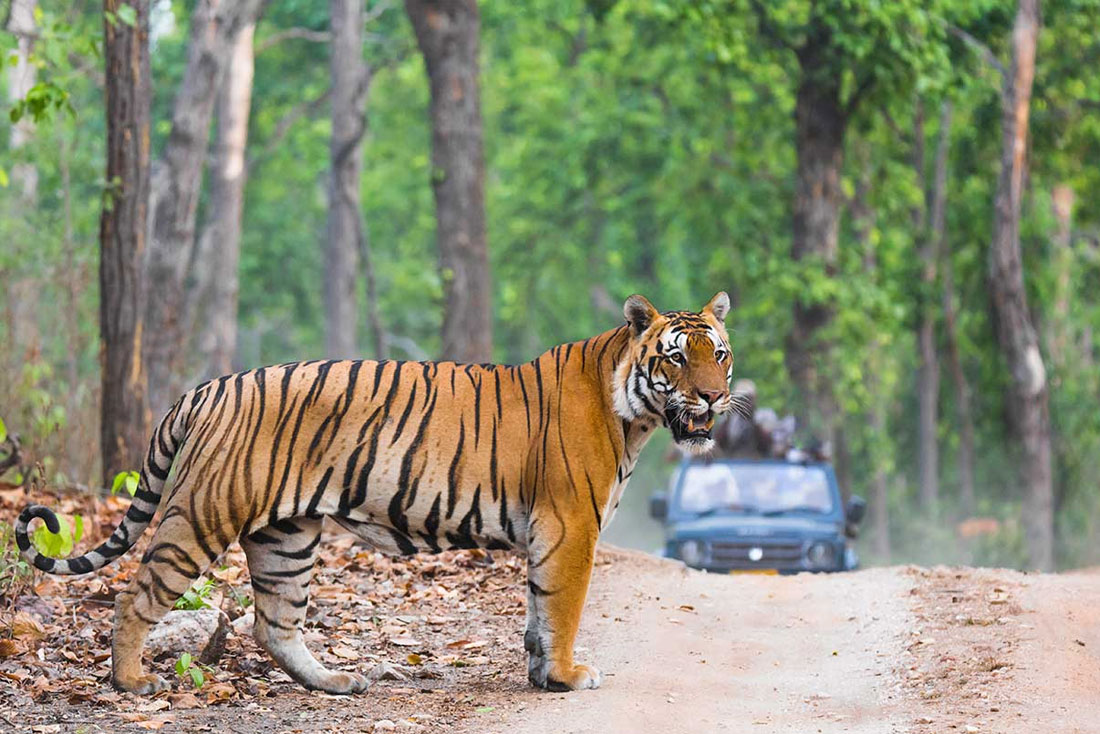
Ranthambore National Park, near Sawai Madhopur, is one of India’s best-known tiger reserves and a powerful addition to a Golden Triangle itinerary. Rolling hills, lakes and dry deciduous forest are dominated by the remains of a massive hilltop fort that watches over the park. This combination of wildlife and history makes Ranthambore particularly atmospheric: it is not unusual to spot deer grazing beneath crumbling walls or a tiger padding past an old temple.
Safaris are carried out in open jeeps or larger canter vehicles that follow designated routes through different zones. While no one can guarantee a tiger sighting, Ranthambore’s relatively high density of big cats means your chances are better here than in many other parks, especially if you plan multiple drives. Even if tigers remain elusive, you are likely to see a wide range of wildlife, from sambar and spotted deer to langurs, crocodiles and many bird species. For travellers willing to add at least two nights to their schedule, Ranthambore can easily become the highlight of the trip.
Typical ticket/safari cost: varies by vehicle type, nationality and zone; expect per-person or per-vehicle pricing for each drive, with premium for private jeeps.
Camera: allowed; some parks charge extra for professional equipment.
Approximate distance from Jaipur: about 180–190 km; often reached by road or train to Sawai Madhopur.
Galtaji Temple: Sacred Springs in the Hills Near Jaipur

Galtaji Temple, tucked into the Aravalli hills just outside Jaipur, feels almost like a hidden ravine city of shrines and sacred pools. The complex consists of several temples and pavilions stacked along a natural gully, with freshwater springs feeding a series of tanks where pilgrims bathe and perform rituals. Weathered pastel facades, carved pillars and curved chhatris reflect in the still water, creating scenes that look like old miniatures brought to life.
The site is also known for its monkey population, which has led some visitors to nickname it the “Monkey Temple.” While the playful animals are part of the charm, it is wise to keep food out of sight and avoid direct contact. Walking up through the complex towards the top ridge rewards you with views over Jaipur’s outskirts and a clearer sense of how the temples sit within the surrounding hills. Because Galtaji is so close to Jaipur, it works perfectly as a half-day outing or a final stop before continuing onward.
Typical ticket price: no entry fee for the complex itself; small camera fee (often around ₹50) is common.
Approximate distance from Jaipur: about 10 km, usually reached by car, taxi or auto-rickshaw.
Suggested Agra–Jaipur Itinerary Structures
Depending on how much time you have, you can treat these stops as quick detours or as the backbone of a multi-day route. The table below shows a few sample structures that work well for different schedules.
| Option | Duration | Main Stops | Who It Suits |
|---|---|---|---|
| Express Transfer with One Stop | 1 long day | Agra → Fatehpur Sikri → Jaipur | Travellers short on time who still want one major historical stop |
| Classic Heritage Detour | 1 full day | Agra → Fatehpur Sikri → Abhaneri → Jaipur | Those keen on architecture and history without wildlife or long delays |
| Birding & History Combination | 1–2 days | Agra → Bharatpur (overnight) → Abhaneri → Jaipur | Nature lovers and photographers who enjoy slow-paced birdwatching |
| Village & Temple Experience | 1–2 days | Agra → Rusirani Village → Fatehpur Sikri → Jaipur → Galtaji | Travellers seeking cultural immersion and spiritual sites |
| Golden Triangle with Tigers | 2–3 extra days | Agra → Fatehpur Sikri → Abhaneri → Ranthambore (2 nights) → Jaipur | Wildlife enthusiasts ready to add a dedicated safari segment |
Cost and Ticket Comparison
While prices can change over time, the table below offers a simple comparison of typical entry costs for key sites on the Agra–Jaipur corridor. Always confirm current fees close to your travel dates, especially if you are budgeting for a group.
| Destination | Approx. Ticket (Indians) | Approx. Ticket (Foreigners) | Notes |
|---|---|---|---|
| Fatehpur Sikri | ₹35 | ₹550 | Complex includes several major monuments; guide fees extra |
| Abhaneri (Chand Baori) | ₹40 | ₹200 | Small site; combine with nearby temple visit |
| Bhangarh Fort | ₹25 | ₹200 | Open only during daylight hours |
| Rusirani Village | Included in tour | Included in tour | Usually part of a package with guide and meals |
| Bharatpur (Keoladeo) | ₹75 | ₹500 | Extra for vehicles, rickshaws and some equipment |
| Ranthambore National Park | Varies by safari | Varies by safari | Per-drive pricing, higher for private jeeps and premium zones |
| Galtaji Temple | Free (camera fee ~₹50) | Free (camera fee ~₹50) | Small contributions and donations appreciated |
Best Time to Travel, What to Pack and Practical Tips
The corridor between Agra and Jaipur spans varied landscapes, but general timing rules still apply. October to March offers the most comfortable conditions for exploring forts, stepwells and outdoor sites, with cooler air and clearer skies. December and January can bring chilly mornings and some fog, especially around Agra and Bharatpur, but midday temperatures are usually pleasant. From April onwards, daytime heat rises sharply, making early starts and air-conditioned vehicles essential.
For wildlife lovers, Ranthambore’s main season typically runs from autumn through late spring, with some zones closing in the monsoon to protect the ecosystem. Keoladeo National Park in Bharatpur is at its liveliest for migratory birds in the cooler months when water levels and food sources attract flocks from afar. Temple visits like Galtaji are possible year-round, but walking in the middle of summer sun can be demanding.
- Clothing: Light, breathable fabrics for daytime, with a light sweater or jacket for winter mornings and evenings. Modest outfits that cover shoulders and knees are best for temples and village visits.
- Footwear: Closed shoes or sturdy sandals work well for uneven paths, fort steps and village lanes.
- Essentials: Sunscreen, sunglasses, a hat, reusable water bottle, basic medicines and copies of key documents. Binoculars are very useful for Bharatpur and Ranthambore.
- Transport: A private car with driver is the easiest way to string these stops together, especially if you want flexibility with timing and photo breaks.
- Respect and etiquette: Ask permission before photographing people, keep noise low in shrines and villages, and follow all guidelines in wildlife areas.
Hidden Details and Less Obvious Highlights
Beyond the headline monuments, each of these places has small, easily missed details that can make your visit feel more personal. At Fatehpur Sikri, for example, you might notice delicate stone lattice windows casting patterned shadows, or inscriptions in Persian script tucked into archways most people walk past quickly. At Abhaneri, watching how light changes across the steps as the sun moves gives a sense of how carefully the structure was aligned.
In Rusirani Village, it may be a shared joke with a family, the taste of freshly cooked flatbread or a child proudly showing you a school notebook that lingers longest in your mind. Bharatpur rewards the patient: spending ten extra minutes at a quiet bend in the path may reveal a rare bird stepping out of the reeds. At Galtaji, an early arrival before the main crowds can turn the complex into an almost meditative space, where you hear only bells, water and occasional monkeys. Keeping your schedule slightly loose lets you notice and enjoy these quieter layers instead of rushing from one viewpoint to the next.
Frequently Asked Questions
Can I visit these stops on a single Agra–Jaipur transfer?
Yes, you can comfortably include one major stop, such as Fatehpur Sikri or Abhaneri, on a same-day transfer. With an early start and a private car, some travellers manage two short visits, but adding more than that usually makes the day very long and tiring.
Is it better to travel from Agra to Jaipur or Jaipur to Agra?
Either direction works. Many itineraries go Delhi → Agra → Jaipur, which means you’ll leave Agra in the morning and have time for a stop on the way to Jaipur. If you start in Jaipur instead, you can simply reverse the order of visits; distances and stops remain similar.
Do I need a guide at each site?
You don’t have to hire a guide everywhere, but using a licensed guide at complex historical sites like Fatehpur Sikri or Bhangarh can add a lot of context. In smaller places or villages, a local escort or driver who knows the area can act as an informal interpreter and fixer.
Is this route suitable for children and older travellers?
Yes, with some adjustments. Choose a limited number of stops per day, avoid very steep or long walks in the midday heat and build in time for rest and meals. Wildlife parks like Ranthambore and gentle cycle rickshaw rides in Bharatpur are often big hits with multi-generation families.
How far in advance should I book Ranthambore safaris?
In peak season, it’s wise to reserve safaris several weeks to a couple of months ahead, especially if you prefer private jeeps or specific zones. Last-minute bookings may be possible in shoulder seasons but often come with fewer choices.
Can I do these places by public transport instead of a private car?
Reaching some major sites like Bharatpur or Sawai Madhopur by train or bus is possible, but combining several hidden stops in one day is much harder without a car. If you’re travelling independently, you might focus on one or two accessible locations and use local taxis from there.
Plan Your Agra–Jaipur Journey With a Private Car and Driver
Turning the Agra–Jaipur drive into a highlight rather than a chore is mainly a question of planning. Once you decide which stops matter most to you – perhaps a deep dive into Mughal history at Fatehpur Sikri, a photography session at Chand Baori, a village encounter at Rusirani, a birdwatching morning in Bharatpur or a full wildlife extension in Ranthambore – the rest falls into place around those priorities. A private car and driver lets you adjust timing, pause for photos and handle luggage without stress between hotels.
If you’d like help building a route that balances monuments, villages, wildlife and practical travel times, you can work with local specialists who know current road conditions, ticket systems and opening hours. With a thoughtful plan, the space between Agra and Jaipur becomes a corridor of stories rather than an empty stretch of highway.
Recent Posts
 Amer Fort Boating 2026 Guide: Maota Lake Tickets & Timings
Discover Amer Fort’s new Maota Lake boating, updated 2026 ticket rates, timings, safety rules and best visiting months.
 Luxury Rajasthan Tour with Oberoi, Taj & Leela Hotels
Experience royal Rajasthan in comfort with Oberoi, Taj and Leela luxury palace stays.
 Luxury Tempo Traveller & Van Hire in India 2026 – Rates, Features & Booking
Enjoy luxury van hire in India for safe, comfortable family and group travel.
 Top 10 Vehicle Hire Companies in India for Tourists
Discover the top 10 vehicle hire companies in India offering safe, comfortable tourist travel.
 Delhi Agra Jaipur Tour by Luxury Car and Private Driver
Enjoy a Delhi Agra Jaipur tour with a luxury car, private driver and flexibility.
 Luxury Car and Driver for Comfortable Rajasthan Tour
Explore Rajasthan in comfort with a luxury car, private driver and flexible custom tour.
 Jaisalmer Travel Guide for Foreign Tourists: Best Time, Desert Tours & Tips
Plan your Jaisalmer trip with ideal seasons, desert tour packages and essential foreigner tips.
 Hidden Villages of Rajasthan: Offbeat Rural Experiences & Village Travel Guide
Hidden Villages of Rajasthan: Offbeat Rural Stays, Homestays & Authentic Village Life.
-
Amer Fort Boating 2026 Guide: Maota Lake Tickets & Timings
Discover Amer Fort’s new Maota Lake boating, updated 2026 ticket rates, timings, safety rules and best visiting months.
-
Luxury Rajasthan Tour with Oberoi, Taj & Leela Hotels
Experience royal Rajasthan in comfort with Oberoi, Taj and Leela luxury palace stays.
-
Luxury Tempo Traveller & Van Hire in India 2026 – Rates, Features & Booking
Enjoy luxury van hire in India for safe, comfortable family and group travel.
-
Top 10 Vehicle Hire Companies in India for Tourists
Discover the top 10 vehicle hire companies in India offering safe, comfortable tourist travel.
-
Delhi Agra Jaipur Tour by Luxury Car and Private Driver
Enjoy a Delhi Agra Jaipur tour with a luxury car, private driver and flexibility.
-
Luxury Car and Driver for Comfortable Rajasthan Tour
Explore Rajasthan in comfort with a luxury car, private driver and flexible custom tour.
-
Jaisalmer Travel Guide for Foreign Tourists: Best Time, Desert Tours & Tips
Plan your Jaisalmer trip with ideal seasons, desert tour packages and essential foreigner tips.
-
Hidden Villages of Rajasthan: Offbeat Rural Experiences & Village Travel Guide
Hidden Villages of Rajasthan: Offbeat Rural Stays, Homestays & Authentic Village Life.