Best Pre‑Wedding Photoshoot Locations in Jaipur (2026): Real Guide for Forts, Streets, Lakes & Desert
If you’ve decided to do your pre‑wedding shoot in Jaipur, you’ve already made one very good decision. The tricky part now is not “Are there enough locations?” but “How do we choose, plan and survive a full day of shooting without feeling like we just ran a marathon in wedding clothes?”. Jaipur is beautiful, yes. It’s also hot, busy and full of stairs. This guide is here to help you enjoy the first part while staying realistic about the second.
You’ll find the real‑world version of a Jaipur pre‑wedding: which spots actually work best in 2026, what kind of vibes they give, how many you can combine in one day, when to avoid the crowds, what to wear where, and why your local photographer sometimes tells you “no, we really shouldn’t add one more location”. Think of this as a long, friendly briefing before you land in the Pink City with suitcases full of outfits.

How to Use This Jaipur Pre‑Wedding Location Guide
You can scroll through this like a catalogue of beautiful places, or you can be a bit more strategic and treat it like a planning tool. The second option will make your life (and your photographer’s life) much easier.
- First, decide the vibe of your album: royal, colourful city, nature, minimalist, or a mix of two.
- Then, pick 2–3 main locations that match that mood instead of trying to cover every famous name in one day.
- Use the tips on timing, light and logistics to build a rough schedule you can share with your photographer or planner.
- Finally, leave a small margin for reality: traffic, crowds, a veil that won’t sit right, or simply needing ten quiet minutes to breathe.
By the time you reach the FAQ at the end, you should have a clear sense of which Jaipur locations are “must‑do” for you, which ones are “nice if we have time”, and how to make the whole day feel more like a fun date than a military operation.
Quick Overview: Types of Pre‑Wedding Locations in Jaipur
Every location in Jaipur falls loosely into a few big buckets. Knowing which category you’re drawn to helps narrow things down quickly instead of drowning in a list of twenty‑plus spots.
| Location Type | Examples | Main Vibe | Best For |
|---|---|---|---|
| Royal forts & palaces | Amer, Nahargarh, Jaigarh | Grand, historical, cinematic | Traditional outfits, royal “prince & princess” feel |
| Lakes & water | Jal Mahal, Man Sagar Lake bank | Calm, dreamy, reflective | Soft sunrise shots, pastel outfits |
| Heritage & gardens | Gatore Ki Chhatriyan, Albert Hall, Sisodia Rani, Kanak Vrindavan | Romantic, detailed, elegant | Close‑ups, intimate portraits, lighter fabrics |
| Urban & colourful | Hawa Mahal streets, Patrika Gate, Jawahar Circle | Lively, bold, “Jaipur on Instagram” | Modern couples, Indo‑western or playful looks |
| Natural & wild | Sambhar Lake, Pushkar dunes, forests, grasslands | Minimal, dramatic, editorial | Statement images, album covers, creative concepts |
| Studios & sets | Artificial sets, indoor streets, theme studios | Controlled, stylised, weather‑proof | Very specific themes, backup options |
If you’re overwhelmed, start with one strong royal fort, one softer garden or heritage spot, and one city or nature backdrop. That mix alone can carry an entire album without ever feeling repetitive.
The Regal Forts & Palaces
Let’s be honest: a big part of the attraction of Jaipur is the chance to look and feel royal for a day. The forts around the city weren’t built with pre‑wedding shoots in mind, but they might as well have been, because the amount of variety they offer in a single location is almost unfair.
Amer Fort: The Epitome of Rajput Grandeur
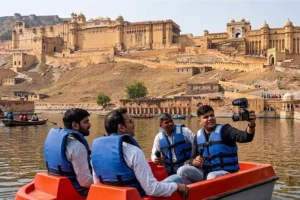
Perched on the Aravalli hills, Amer Fort is a masterpiece of Rajput–Mughal architecture. Massive gates, mirrored halls, courtyards, painted ceilings, long corridors, views over the lake – you could honestly spend an entire shoot here and still leave with ideas unused. That’s exactly why it’s usually at the top of every Jaipur pre‑wedding list.
The trick is to enjoy Amer without getting swallowed by the crowd.
- Aim for the first hour after opening. That’s when the light is soft and the tour buses haven’t fully taken over yet.
- Plan specific spots in advance: for example, Sheesh Mahal for the mirror magic, a big arched doorway, and one terrace for a wide shot with hills and Maota Lake.
- Wear something you can walk in. The fort has stairs, slopes and uneven flooring. You can always change shoes between shots.

If you love heavy lehengas and sherwanis, Amer is where you bring them out. The fort can handle as much drama as you want to throw at it.
Nahargarh Fort: Jaipur from Above
Nahargarh Fort was built as a retreat, and it still feels like one. The main reason couples come here is the view: the whole city unfolds below, changing colour as the sun drops. Inside, you get frescoes, courtyards and terraces with just enough wear and tear to feel authentic, not fake‑polished.
- Sunset is prime time. Nahargarh faces west, so the stone walls catch a warm glow while the city slowly lights up.
- It works brilliantly for silhouette shots on walls and rooftops, as well as softer, closer portraits in fading light.
- Bring a light extra layer in winter – the breeze up here can get surprisingly cool once the sun is gone.

Jaigarh Fort: The Imposing Sentinel
Jaigarh is more rugged and military in feel. While Amer shows off with artwork and mirrors, Jaigarh leans on thick walls, watchtowers and long, straight ramparts. It’s home to the massive Jaivana cannon and offers even more hill views.
- Late afternoon is ideal: the light brings out the texture in the stone and creates strong shadows along the walls.
- Use the long ramparts as leading lines to pull the viewer’s eye straight to you.
- If you want a slightly more “serious” or editorial set of images in your album, Jaigarh is a great contrast to softer locations.

Jal Mahal: The Floating Palace
Jal Mahal is that palace you see sitting in the middle of a lake and instantly think, “Okay, that cannot be real.” It is, and it makes for one of the dreamiest backdrops in Jaipur. You can’t go inside the palace itself, but honestly, the magic is in the view from the shore.
- For the famous reflection shot, you need very still water, which usually means early morning, before wind and boats disturb the surface.
- Stand on the eastern bank so the rising sun lights up the palace in front of you instead of blinding your faces.
- This is a perfect “warm‑up” location: simple poses, wide compositions, and then you move on to your bigger fort or city locations.

Architectural Gems & Lush Gardens
After big forts, a lot of couples appreciate locations that feel a bit more human‑sized. Places where you can slow down, talk, laugh, and focus on each other rather than constantly looking for the next massive wall.
Gatore Ki Chhatriyan: Quiet Royal Cenotaphs
Gatore Ki Chhatriyan is one of those spots locals recommend when you say, “We want something beautiful but not packed with people.” It’s a complex of royal cenotaphs, each with carved pillars, domes and delicate stone latticework. The whole place has a calm, slightly nostalgic feel.
- The jali (lattice) work behaves like a natural light filter: let sunlight pass through it to paint soft patterns on your clothes or faces.
- Mid to late afternoon works well – the sun angle starts to drop, giving you depth without being too harsh.
- It’s great for slower, more emotional, close‑up shots after a high‑energy morning at Amer.
Panna Meena Kund: Graphic Geometry Near Amer
Panna Meena Kund is an ancient stepwell close to Amer Fort, famous for its criss‑crossing staircases. From the right angle, the symmetry is almost hypnotic. It’s the sort of place where one strong, well‑planned frame can become everyone’s favourite.
- To show the full pattern, shoot from above or from a corner that lets you see multiple staircases at once.
- Late afternoon creates pronounced shadows that carve out the steps and make the geometry pop.
- If rules about walking on the steps change, respect them – you can still get great angles without standing in the middle.

Albert Hall Museum: Classic Indo‑Saracenic Drama
Albert Hall Museum, sitting in Ram Niwas Garden, is one of those buildings that looks good at almost every time of day, but truly comes into its own at dusk when the lights switch on. Dome, arches, balconies and a broad facade give you that grand, old‑world museum vibe without needing to step inside at all.
- Use the garden paths to frame the building and the couple with trees or flowerbeds.
- As the sky darkens, a slower shutter speed will let the warm building lights glow while you hold a pose in the foreground.
- It’s a nice “evening city” alternative if you don’t want to go high up to Nahargarh.

Sisodia Rani Garden: Terraces Built for a Queen
Sisodia Rani Garden feels like a secret royal escape: terraced levels, fountains, painted pavilions, flowerbeds and hills around. It’s big enough to explore but compact enough that you don’t spend half the time just walking from one end to the other.
- Use the different levels to create multi‑layered images: one of you above, one below, or both framed by stairways and railings.
- Morning light makes the greens and flower colours pop without too much contrast.
- Outfits with flow – skirts, dupattas, long jackets – look especially good here when they catch a little breeze.
Kanak Vrindavan: Temples, Water and Hills
On the way to Amer, Kanak Vrindavan combines temple structures, pools, lawns and distant hills. It’s quieter than city‑centre spots and works well if you want a touch of spirituality without going to a very intense or crowded temple.
- Temple doorways and carved pillars make natural frames around the two of you.
- The golden hour before sunset does beautiful things to the yellow stone and surrounding greenery.
- You can pair it with Jal Mahal or Amer in the same half‑day since the locations sit along a similar route.
Vibrant Urban & Cultural Backdrops
Royal forts are great, but a lot of couples also want their album to feel like Jaipur – busy, colourful, slightly chaotic, full of life. The following spots give you that energy without turning the whole shoot into a fight with traffic.
Hawa Mahal Streets: The Famous Pink Facade
Shooting in front of Hawa Mahal from the street is almost a rite of passage. The facade is incredibly detailed and immediately recognisable, but so are the honking bikes, shop signs and curious onlookers. The challenge is to use that reality rather than be defeated by it.
- Arrive right around sunrise for a softer, calmer version of the street before it fully wakes up.
- Check out cafés or shops with upper floors across the road – some have balconies or windows with perfect straight‑on views.
- Let a bit of everyday life into your frame: a cycle rickshaw, a local walking past, a chai stall behind you. It adds context and charm.

Patrika Gate: The Colour Explosion
Patrika Gate is not ancient, but it is absolutely spectacular on camera. Each archway inside is painted with scenes and motifs from Rajasthan, and the repeating arches create a tunnel of art. It’s one of those places where you stand in the middle, turn in a circle, and every direction looks like a different set.
- Wear something that either really matches the colours or clearly contrasts them. Beige on pastel can disappear; deep jewel tones stand out.
- Late afternoon offers even light without harsh top shadows, which is ideal for all that paint detail.
- Get a mix of wide shots showing full arches and tight frames on the paintings and your expressions.

Jawahar Circle Garden: Green Calm Next to the Gate
Right next to Patrika Gate, Jawahar Circle Garden is a large, circular park with lawns, walking paths, rose plants and fountains. After the intensity of the painted arches, it gives your eyes and your mood a breather.
- Use the long paths as leading lines for walking‑together shots.
- Fountains, if they’re running, add motion and a soft blur behind your poses.
- This is an easy place to do more natural, “we’re just hanging out” photos in simpler outfits.

Natural Landscapes & Unique Terrain
If forts and painted gates aren’t enough for you, the areas around Jaipur offer some of the most surreal natural backdrops in North India. They do require extra effort – more driving, earlier alarms, more logistics – but the payoff is huge if you want photos nobody else in your circle has.
Sambhar Lake: India’s Salt Mirror
Sambhar Lake, roughly 95 km from Jaipur, is India’s largest inland saltwater lake. In its dry phases, huge stretches become white salt flats that look like snow at first glance. Add a big sky and a bit of water for reflections, and it starts to feel more like a dream than a real place.
- Bold colours – deep reds, rich blues, bright dupattas – explode against the white ground.
- Sunrise and sunset are both incredible, but also when temperatures are most tolerable.
- Go with a local crew who knows which areas are currently safe and allowed for shoots; this is not the place to freelance your way in.

Pushkar Desert: Classic Golden Dunes
Pushkar, around 150 km from Jaipur, brings you into proper desert territory. The sand dunes, camel silhouettes and low sun are exactly the kind of visuals people think of when they say “Rajasthan”. It’s a big effort for a shoot, but if dunes have been on your mind, this is where they come to life.
- Plan either an overnight stay or a very long day with careful timing; you don’t want to be in the dunes during mid‑day heat.
- Golden hour does most of the magical work: long shadows, warm tones, almost no need for artificial light.
- Expect wind and sand. Choose hairstyles and outfits that can actually handle movement and a bit of chaos.

Chaksu Forest: Green Shade and Light Beams
Chaksu Forest and similar wooded areas near Jaipur are your answer if you want softer, green‑heavy photos. Sunlight cutting through leaves, narrow paths, tree trunks forming natural frames – it’s a completely different mood from stone and sand.
- Mornings are best: cooler air, softer rays through the canopy, fewer insects out.
- Earthy tones, creams, greens and flowing dresses blend beautifully with the environment.
- It’s a great place to capture candid moments – walking, joking, exploring – rather than stiff posing.

Grasslands & Banas Bridge: Rustic and Open
Open grasslands around Jaipur and spots like Banas Bridge (towards Tonk) offer a nice in‑between: not as extreme as desert or salt flats, but still very different from the city. Think big skies, long grass glowing at sunset, simple bridges over water, faraway hills.
- For grasslands, pick sunset and let the sky and silhouettes do half the storytelling for you.
- On a bridge, play with perspective: shoot along its length, between beams, or from below looking up.
- These spots are perfect for more relaxed, “date‑day” outfits that show who you are outside of wedding clothes.

Creative Studios & Unconventional Spots
Sometimes, real life just doesn’t match the exact mood board in your head. That’s where studios with built sets and completely unconventional places step in. You trade a bit of authenticity for full control and very specific aesthetics.
Artificial Set Studios: When You Want a Movie
Studios like Destination of Picture or big film‑style complexes around Jaipur build entire fake streets, palace interiors, vintage rooms and fantasy corners. The advantage is simple: whatever the weather, whatever the crowds, your set is waiting for you, lights ready, props nailed in place.
- These sets work best when everything matches the theme – outfits, make‑up, props, poses, even your expressions.
- You can cover multiple “worlds” in one half‑day: a royal corridor, a European street, a cosy café corner.
- Talk through your ideas with the studio and your photographer well in advance so nobody is improvising on the day.

Dumping Yard, Kishangarh: Surreal Marble Hills
The marble slurry dumping yards around Kishangarh have become unexpectedly famous in the wedding world. The white mounds of marble dust and slurry form hills and ridges that look almost like glaciers or alien dunes. It’s strange, striking and unlike anything most people have seen in person.
- This is not a casual walk‑in spot. You need local guidance, permissions and a serious safety mindset.
- Dramatic outfits – deep colours, long trains, capes – photograph incredibly well against the stark white shapes.
- If you’re after that one insane, high‑fashion image in your album, this might be it, but treat it as a special project, not an add‑on at the last minute.

Practical Planning: Season, Timing, Permits and Outfits
Knowing locations is fun. Actually turning them into a smooth day is where planning comes in. Here are the big practical pieces that most couples only discover the hard way if nobody tells them early.
Best Time of Year for a Jaipur Pre‑Wedding Shoot
For 2026, the rule hasn’t changed: if you want to enjoy your day instead of just surviving it, aim for October to March.
- Late October – November: Slightly warm days, pleasant mornings and evenings, clear skies.
- December – February: Cool mornings, mild afternoons, lovely light. Pack a shawl or jacket for sunrise shoots.
- March: Warming up, but still manageable if you avoid mid‑day.
Try to avoid:
- April – June: High heat, fast dehydration, make‑up struggling to hold up, outfits feeling twice as heavy.
- July – September: Monsoon, unpredictable showers, muddy patches, flat grey or white skies on many days.
Daily Timing and Light
Within a single day, timing can transform the same place from “okay” to “incredible”.
- Sunrise: best for Jal Mahal, Hawa Mahal streets, and quieter versions of Amer or Panna Meena.
- Late afternoon to golden hour: ideal for gardens, forts overlooking the city, grasslands and deserts.
- Evening / blue hour: great for Albert Hall, city views, and a final romantic set in soft light.
Treat the harsh mid‑day sun as a natural break. Eat, hydrate, move locations, fix hair and make‑up. There is no award for proving you can pose at 1 p.m. in May on top of a stone fort.
Permits, Entry Fees and Local Help
Almost every big monument has two modes in the eyes of the staff: “tourists taking a few pictures” and “full‑on professional shoot”. If you turn up with multiple cameras, light stands, reflectors and outfit racks, you’re clearly in the second category.
- Expect to buy standard entry tickets for you and your photographer at forts and museums.
- For serious gear or commercial intent, you may also need a separate photography/filming permit issued in advance.
- A good local photographer or planner usually knows which places are strict, which are relaxed and how long paperwork takes.
This is one of those areas where spending a bit more to do it properly saves you from losing precious time arguing at a gate on the day.
Wardrobe and Styling: Looking Great Without Torturing Yourself
Beautiful outfits are half the fun of a pre‑wedding shoot, but they shouldn’t turn the whole day into an endurance test. A few common‑sense choices go a long way.
- Limit yourself to 2–3 outfits in one day. One heavy traditional, one lighter Indo‑western, and maybe one casual set is plenty.
- Match your look to the location: royal for forts, soft and flowy for gardens, bold and playful for colourful city spots.
- Carry a “mini emergency kit”: pins, safety clips, tissues, compact powder, lipstick, comb, water, and maybe a tiny handheld fan in summer.
Talk honestly with your make‑up artist about the fact that you’ll be outside, moving and sweating, not sitting under studio lights. A slightly more natural, locked‑in look will usually age better over the course of a long day than something ultra heavy and fragile.
Frequently Asked Questions (FAQs)
Do we need special permission for a pre‑wedding shoot at Jaipur’s forts?
For a fully planned pre‑wedding shoot with professional equipment, yes, you usually do. Normal tickets cover casual tourist photos, but tripods, lights and multiple outfit changes can trigger the need for a commercial photography permit, especially at ASI and state‑managed sites. The simplest, least stressful approach is to let a local photographer or planner handle these permissions for you.
What is the best time of year for a pre‑wedding shoot in Jaipur?
The most comfortable and reliable window runs from late October to early March. Days are typically sunny and pleasant, with cooler mornings and evenings. This makes sunrise and sunset shoots enjoyable instead of painful. Extreme summer months and peak monsoon are still possible with careful planning, but you trade comfort and flexibility for extra effort.
Can we shoot from inside Hawa Mahal or Jal Mahal?
Hawa Mahal is usually shot from the street or from cafés and buildings opposite; professional setups inside the narrow interior spaces are very limited and often restricted. Jal Mahal itself is presently not open to the general public, so all photography happens from the lake banks or roadside viewpoints. The good news is that both monuments look their best from a little distance anyway.
How many locations can we realistically cover in one day?
For a relaxed, high‑quality shoot, aim for two main locations plus one quick bonus stop. For example: Jal Mahal at sunrise, Amer Fort in the morning, break at the hotel, then Gatore or Patrika Gate in the afternoon. Trying to squeeze in five or six spots usually means more time in traffic, less time actually shooting, and photos where your faces quietly say, “We are exhausted.”
Are the desert and salt lake locations really worth the extra travel?
If you want images that look and feel completely different from the usual fort‑and‑gate pictures, absolutely yes. Sambhar Lake, Pushkar dunes and similar spots create minimal, otherworldly frames that often end up as album covers and main wall prints. Just be realistic about the extra travel time, early starts, and need for local guidance to keep everything safe and legal.