Women Solo Travel Golden Triangle: Safety Tips & Essential Guide 2026
Every woman considering a journey through India's Golden Triangle carries a particular set of concerns that men often don't. Not paranoia—realistic precautions grounded in genuine awareness of how different cultures operate and where vulnerabilities exist. The question isn't whether the Golden Triangle is safe. It is. Rather, the real question is: how do you travel through it confidently, comfortably, and with the knowledge that you've done everything reasonable to protect yourself?
I've guided countless women through Delhi, Agra, and Jaipur over years of working with international travelers. I've watched nervous first-time visitors arrive uncertain and depart having experienced profound moments of connection and wonder. What changes that trajectory is preparation, not fear. Understanding the environment. Knowing realistic precautions. Learning how to navigate with awareness rather than anxiety.
This guide reflects that perspective. It's not meant to discourage women from traveling to the Golden Triangle. Rather, it provides honest, practical information that transforms vague worry into concrete knowledge. You'll understand the actual safety situation, what precautions genuinely matter, how to move through these cities with confidence, and when flexibility and cultural awareness serve you better than rigid rules.
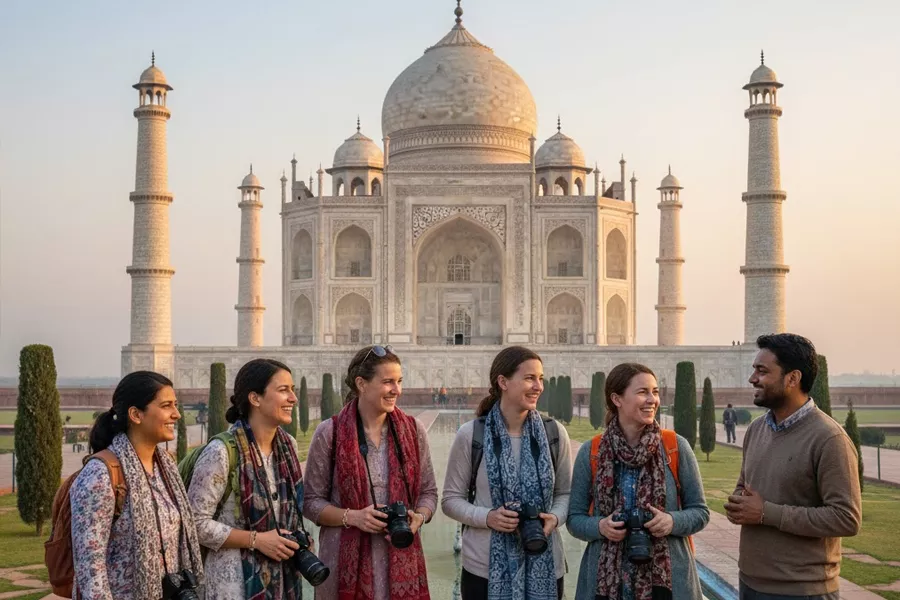
Understanding the Golden Triangle: Context and Reality
The Golden Triangle—Delhi, Agra, Jaipur—represents India's most developed tourist circuit. These three cities attract over 10 million international visitors annually. The infrastructure exists to serve them: licensed guides, vetted hotels, established transportation routes, tourist police units, and cultural understanding built through decades of international engagement.
This matters fundamentally. Compared to lesser-visited regions of India, the Golden Triangle operates with established safety infrastructure. Police are accustomed to international visitors. Hotels understand security protocols. Guides speak English and understand cultural expectations. This isn't to say these cities are sterile tourist bubbles. They're not. They're authentically Indian—messy, chaotic, intense. But the chaos is navigable when you understand what you're encountering.
The honest reality of harassment
Women do face unwanted attention in India. Staring is genuine and can feel uncomfortable. Catcalls happen. Physical harassment on crowded public transport occurs. Scams targeting foreigners exist. These aren't myths. However—and this distinction is crucial—these problems are substantially reduced when you travel with established transport (private cars or official taxis), stay in good hotels, use licensed guides, and move through tourist areas during daylight.
The women facing the most difficult experiences are usually those using chaotic public transport, staying in very cheap accommodations, traveling alone through rural areas at night, or combining poor planning with bad luck. None of these are necessary if you're traveling the Golden Triangle as a typical tourist.
Is the Golden Triangle Safe for Women? The Balanced Assessment
Yes, the Golden Triangle is safe for women travelers when approached with realistic precautions. This isn't corporate marketing speak—it's the honest assessment based on millions of annual visitors, decades of established tourism infrastructure, and the fact that women continue returning to these cities year after year.
However, "safe" requires context. New York City is safe, yet you wouldn't walk through certain neighborhoods at 3 AM alone. Bangkok is safe, yet you'd avoid certain red-light districts at night. The Golden Triangle operates similarly. It's genuinely safe within reasonable parameters of awareness and precaution.
What feels genuinely safe
Walking through major markets (Bapu Bazaar, Johari Bazaar) during daylight hours. Visiting monuments with official guides or in organized groups. Taking pre-arranged private cars or official taxis versus hailing random autos. Staying in hotels with good reviews in central areas (Connaught Place Delhi, Fatehabad Road Agra, C-Scheme Jaipur). Eating at restaurants and street food stalls busy with locals and tourists. Having honest conversations with hotel staff about safe areas and activity timing.
Women do all these activities daily, often alone. They shop, explore, photograph, and return to their hotels without incident. The experience feels normal—sometimes wonderful, sometimes exhausting, occasionally uncomfortable, but fundamentally safe.
What requires additional awareness
Solo nighttime walks through unfamiliar neighborhoods. Using unregistered taxis late at night. Staying in extremely cheap accommodations in obscure areas. Wearing obviously expensive jewelry and traveling with obvious cameras in crowded bazaars. Accepting rides from friendly strangers. Going to isolated temples or forts at sunset without others. These activities don't guarantee problems, but they increase risk substantially and aren't necessary for enjoying the Golden Triangle.
Practical Safety Precautions for Women Travelers
Clothing choices: Modesty without extremism
India remains a conservative culture. Women in modest dress attract less attention than those in revealing clothing. This isn't endorsement of a dress code—it's realistic observation about cultural norms and your experience.
In practice, this means: long pants or skirts (knee-length minimum), tops with sleeves or high necklines, avoiding tight-fitting garments. Jeans with tunics or loose t-shirts work perfectly. Salwar kameez (traditional Indian pants with tunic) is both respectful and genuinely comfortable in Indian heat. A lightweight scarf or dupatta is invaluable—it covers shoulders when needed at temples, adds modesty in conservative areas, and serves practical purposes (head covering during sun exposure, securing loose clothing on crowded buses).
In tourist-heavy areas (Taj Mahal complex, Jaipur's City Palace, Delhi's major markets), you'll see women in various states of dress. Shorts are worn. Sleeveless tops appear. This is genuinely acceptable in these areas. However, moving away from main tourist zones—small neighborhood temples, rural villages, conservative neighborhoods—modest dress significantly improves your experience and reduces unwanted attention.
Expensive jewelry attracts attention. Leave flashy items at home. Simple pieces are fine. Likewise, expensive cameras draw unwanted attention in crowded bazaars where theft does happen. Older cameras, phone-only photography, or obviously used equipment are less tempting targets.
Handling staring and unwanted attention
Foreign women attract stares in India. Often lots of staring. It's usually curiosity rather than hostility—you look different, speak differently, move differently. Indians sometimes want photos with foreign visitors (particularly older people and children). This isn't inherently threatening, though it can feel invasive when you're tired and want privacy.
Strategies that work: make eye contact and smile briefly, then redirect attention elsewhere. This acknowledges them without encouraging further interaction. Wearing sunglasses reduces staring intensity (eye contact is harder). Moving with purpose and confidence—not hesitant or lost—deters unwanted attention. When someone requests a photo and you're uncomfortable, a polite "No, thank you" with a smile ends it quickly. In more crowded bazaars where staring intensifies, earbuds (whether music is playing or not) signal unavailability.
If staring escalates to catcalls or touching, move toward other tourists, shopkeepers, or police. These individuals are present throughout tourist areas. A calm but firm response ("Don't touch me") attracts attention that usually deters further behavior.
Maintaining awareness without paranoia
Street smarts are different from fear. You're aware of your surroundings without constantly anticipating the worst. Notice where police are stationed. Be conscious of which neighborhoods feel busy and commercial versus quiet and residential. Know where your hotel is in relation to major landmarks. Check your phone location periodically to understand your position. These habits become automatic and require minimal mental energy.
Trust your gut. If a situation feels genuinely wrong—a shop feels predatory, a driver seems aggressive, a neighborhood feels hostile—trust that instinct and leave. Often the situation is fine, but sometimes your subconscious picks up on details your conscious mind hasn't yet processed. It's worth the awkwardness of moving away.
Transportation Safety: The Most Important Decision
How you move between cities and within them matters more than almost any other variable. This is where safety differences become most pronounced.
Private car with driver: Strongly recommended
Hiring a private car with professional driver for intercity travel (Delhi-Agra, Agra-Jaipur) offers several advantages beyond safety. You control timing, pacing, bathroom breaks, and food stops. You're not confined to rigid schedules. The driver becomes a resource—asking recommendations, seeking guidance on safe neighborhoods, learning about local culture. Most importantly, you're not navigating public transport systems alone, a significant source of stress for solo women travelers.
Cost: approximately ₹28-₹35 per km. For two people or a small group, this divides reasonably. A private car from Delhi to Agra costs roughly ₹2,500-₹3,000 total, or ₹1,250-₹1,500 per person. This is comparable to train tickets but offers superior comfort and control.
Verify driver legitimacy: licensed vehicles, professional appearance, verifiable background through the operator. Avoid random driver solicitations at airport or train stations. Use established companies or book through hotels.
Trains: Generally safe but complex
India's trains are genuinely safe for women, with dedicated women's compartments available. However, they require navigation complexity (understanding class systems, compartment types, luggage handling, station chaos) that can be exhausting when traveling solo. The Rajdhani and Shatabdi Express connecting these cities are clean, air-conditioned, and well-maintained. You'll meet other travelers and have a fundamentally Indian travel experience.
The catch: you still need local transport in each city to reach your hotel or attractions. Managing luggage alone at stations, navigating autorickshaws or apps to reach accommodations, adds stress that a private car eliminates. If you enjoy trains and have flexible energy, absolutely try it. Many women do. But be realistic about the coordination required.
Ride-sharing apps in cities: Convenient with caution
Uber and Ola operate safely in Delhi, Agra, and Jaipur for daytime and evening city travel. Apps provide driver details, vehicle information, GPS tracking, and ride history—all meaningful safety features. You can share location with friends during rides. Drivers are professional and understand expectations.
Use these for moving around cities during typical hours. Avoid apps late at night (after 11 PM) when driver availability decreases and prices surge significantly, sometimes attracting less-vetted drivers. During daylight and early evening, apps feel genuinely safe and are convenient for spontaneous exploration.
Autorickshaws and taxis: Context-dependent
Autorickshaws are chaotic, crowded, and often difficult to negotiate as a solo woman unfamiliar with routes. In busy daylight hours in central areas, they're fine. At night or in isolated areas, they carry more risk. If using auto-rickshaws, use them during daylight, in busy commercial areas, and never late at night. Negotiate fare beforehand to avoid disputes. Sit close to windows where you're visible to the street.
Random street taxis carry more risk. While many are legitimate, others are not. The expense difference between a pre-arranged car and a random taxi is minimal—use arranged transportation consistently.
Night travel: Best avoided
Avoid traveling between cities at night. Overnight trains and buses require long periods of reduced vigilance. Highways at night present different risks than daytime travel. Instead, travel during daylight hours (5 AM-6 PM departure from major cities gets you to your destination before dark). This seems inconvenient but eliminates a substantial category of potential issues.
Accommodation: Choosing Where to Stay
Your hotel or guesthouse becomes your base, the place you retreat to for rest and privacy. Choosing thoughtfully significantly impacts your overall experience.
Location prioritization
Central areas with established tourist infrastructure are consistently safer and more convenient. In Delhi: Connaught Place, Khan Market, Pahar Ganj (despite being backpacker-heavy, it's safe and familiar). In Agra: Fatehabad Road (main tourist thoroughfare), areas near Taj Mahal's main gate. In Jaipur: C-Scheme, Bani Park, areas near City Palace and Hawa Mahal. These locations have police presence, busy foot traffic, established restaurants and shops, and staff familiar with international guests.
Remote, cheap accommodations in unfamiliar neighborhoods aren't worth the money saved. The stress of figuring out location, navigating back at night, feeling isolated—these costs exceed any financial savings.
Research and verification
Read recent reviews specifically from women travelers. TripAdvisor and Google reviews include detailed comments about safety, cleanliness, noise, staff behavior. Look for consistent patterns rather than single mentions. Complaints about staff behavior toward women are serious—believe them. Praise for safe neighborhoods and attentive staff is reassuring.
Contact the hotel directly via phone or email before booking. Speak with management. Ask about security, neighborhood safety, female staff availability, transportation assistance. Professional hotels respond helpfully. Evasive responses are red flags.
Mid-range vs budget: Value calculation
Budget accommodations (₹1,000-₹1,500 per night) can be safe and good, but require more careful verification. Mid-range hotels (₹2,000-₹4,000 per night) consistently offer security features, professional staff, reliable facilities, and peace of mind that justify the expense for solo women travelers. The extra cost is insurance against numerous small problems that drain your energy. Don't obsess over budget—allocate it toward accommodation that provides genuine comfort.
Hotel staff: Respectful relationships matter
Hotel staff are valuable allies. Front desk personnel provide recommendations on restaurants, safe areas, local transportation. Establish a respectful relationship—be friendly but professional, thank them for assistance, ask for their suggestions. Most staff are genuinely helpful, and many take pride in ensuring guest safety.
Conversely, if a staff member makes you uncomfortable—unwanted comments, intrusive questions, physical closeness—trust that feeling and consider changing hotels or requesting different staff for assistance. Your comfort is the priority.
Solo Women vs. Small Group Travel: Different Experiences
Solo travel advantages
Complete flexibility. You move at your pace, spend as long as you want at monuments, eat where you choose, rest when needed. You meet more local people and other travelers when alone—people are friendlier toward solo women in many cultural contexts. You have freedom to respond to spontaneous opportunities and change plans without committee discussion.
Solo travel challenges: logistics feel heavier when only you manage them. Unwanted attention can feel more focused. Restaurant experiences feel less comfortable dining alone. Cost-sharing isn't available for transport or accommodations.
Small group (2-3 women) advantages
Shared transport costs reduce per-person expenses significantly. Collective energy disperses unwanted attention. Logistics feel lighter when divided. Restaurant experiences are more comfortable. Support is immediate if anyone faces difficulties.
Small group challenges: finding compatible travel partners requires effort. Scheduling conflicts emerge. Personality friction accumulates on intensive travel. One person's illness or injury affects everyone.
The realistic assessment
Both solo and small group travel work perfectly well in the Golden Triangle. Neither is demonstrably "safer"—both require awareness and precaution. Solo travel actually attracts less attention in many contexts (solo women are seen as purposeful travelers, not vulnerable targets). Small groups provide emotional support that makes the intense experience of India more manageable.
Choose based on your personality and circumstances, not on theoretical safety differences. Women successfully travel both ways.
Monuments, Markets, and Cultural Experiences
Monument visiting: Guided vs. independent
The Taj Mahal, Agra Fort, Jaipur's major sites—all are genuinely safe for women to visit independently. Security is substantial. Police presence is evident. Crowds are heavily international and domestic tourists. Wandering through these monuments alone feels normal and doesn't attract problematic attention.
However, hiring a licensed guide (₹500-₹800 for 2-3 hours) enriches the experience substantially. Guides provide context that independent exploration misses. They navigate crowds efficiently. They're familiar with optimal timing and less-crowded routes. For first-time visitors unfamiliar with India, guides reduce sensory overwhelm and enhance understanding.
Request female guides if available and if that increases your comfort. Most tourist companies accommodate this request. Female guides are particularly valuable in religious spaces where gender dynamics might feel different.
Bazaar shopping: Navigation strategies
Bazaars are intense. Narrow lanes, pressing crowds, aggressive shopkeepers, sensory overload. For first-time visitors particularly, bazaar shopping can feel overwhelming. However, bazaars are also where authentic Rajasthan lives—where genuine handicrafts, textiles, and local energy reside.
Strategies that help: go early morning (8-9 AM) when crowds are manageable. Bring a friend or travel with your hotel's recommended guide initially. Set specific items you're seeking rather than open-ended browsing. Say "no" firmly without guilt when shopkeepers push items. Never feel obligated to buy because a shopkeeper has been friendly—hospitality and sales pressure can coexist. Carry bags worn across your body, never loose on shoulders. Keep valuables secure.
If bazaar shopping feels too intense, many hotels can recommend stores outside bazaars where similar items are available in calmer environments. It's worth spending more to avoid exhaustion.
Religious spaces: Cultural respect and safety
Temples and mosques welcome respectful visitors of all religions and backgrounds. However, follow basic protocols: remove shoes when required, cover shoulders and head with scarves in conservative spaces, ask permission before photographing in prayer areas, observe ritual activities respectfully. These aren't just safety measures—they're cultural respect that locals genuinely appreciate.
Women can visit all major religious spaces. Some temples have women-specific prayer areas. Periods are not a barrier to entering religious spaces despite old myths. Follow local customs when visible, but don't invent restrictions that don't exist.
Common Scams and How to Avoid Them
Commission shops and commissions
Many tourist guides, drivers, and hotel staff receive commissions when directing you to specific shops. This isn't inherently problematic—commissions ensure operators recommend places they trust. However, it also means prices are marked up 30-50% to account for commissions.
Solution: ask directly: "I'd prefer shops without commissions." Honest operators will respect this. Alternatively, visit government handicraft stores (Seema Gram in Jaipur, etc.) or directly seek out artisans, both of which bypass commission structures.
Overpricing for foreigners
Prices for foreigners in bazaars are often higher than for Indian customers. Shopkeepers will charge whatever they believe you'll pay. Bargaining is the mechanism that corrects this. Research typical prices beforehand (ask hotel staff, chat with other travelers). Know reasonable price ranges. Use this as your baseline for negotiation.
Fake items and quality misrepresentation
Marble inlay work is sometimes composite material instead of actual marble. Block printing is sometimes machine-made, not handmade. "Pure silk" is sometimes synthetic blends. The solution: buy from established reputation sources. Compare items across multiple shops. Ask detailed questions about materials and production methods. Request documentation for valuable items.
Romance scams
Local men occasionally befriend solo women with romance intentions, expecting financial support or marriage promises. This is less a safety issue than an emotional one—people being dishonest about intentions. Solution: be aware of this dynamic, maintain healthy skepticism about rapid romantic intensity, and remember that meaningful relationships rarely develop over a few days of tourism.
Best Seasons: When to Travel
Peak season (October-March): Optimal but crowded
Weather is perfect (15-25°C), crowds are substantial, prices are highest. Monuments are packed. Bazaars overflow. Despite crowds, this remains the easiest season for women travelers—comfort and visibility are highest. December-January are the busiest months. October-November and February-March see fewer crowds with still-pleasant weather and equivalent safety.
Shoulder seasons (April-May, September)
Moderate weather, reduced crowds, lower prices. April heat begins climbing but mornings remain pleasant. September is post-monsoon. These seasons offer reasonable compromise between comfort and overcrowding.
Off-season (June-August): Challenging but possible
Intense heat (40-45°C), monsoon moisture, minimal crowds, dramatic price reductions. Heat is genuinely harsh—outdoor sightseeing becomes difficult. However, if you're able to travel early morning, rest midday, and resume evening exploration, the reduced crowds and authentic local experience have value. Avoid this season if heat significantly impacts your comfort or health.
Safety Checklist for Women Travelers
| Travel Aspect | Safety Recommendation | Why It Matters |
|---|---|---|
| Intercity Travel | Book private car with licensed driver or official train compartments. Avoid night travel. | Eliminates navigation stress, provides personalized service, maintains control over timing. |
| City Transport | Use Uber/Ola during daylight/early evening. Pre-arrange taxis or ask hotel for recommendations. | Apps provide tracking, driver details, and accountability. Reduces negotiation friction. |
| Accommodation | Mid-range hotels in central areas with good reviews. Research locations beforehand. | Professional staff, secure facilities, proximity to restaurants/shops, reduced isolation. |
| Clothing | Long pants/skirts, covered shoulders, loose-fitting tops. Carry scarf for temples. | Reduces unwanted attention, shows cultural respect, makes experiences more comfortable. |
| Valuables | Minimize jewelry, avoid expensive cameras, carry money in money belts or hotel safes. | Reduces theft risk and unwanted attention from potential criminals. |
| Sightseeing | Visit major monuments in daytime hours. Use official guides. Stay in groups if possible. | Police presence is substantial, crowds ensure visibility, guides provide security and context. |
| Shopping | Visit bazaars early morning. Bargain respectfully. Research prices beforehand. Use cross-body bags. | Manages overwhelming atmosphere, reduces confusion and overcharging, minimizes theft risk. |
| Communication | Get local SIM or data plan. Share location with trusted friends. Maintain fully charged phone. | Enables emergency contact, map navigation, cab apps, peace of mind for worried loved ones. |
| Documentation | Carry passport copy separately. Keep digital copies in email. Know emergency numbers (100, 1091). | Enables quick response if documents are lost, facilitates emergency assistance. |
Frequently Asked Questions About Safe Golden Triangle Travel for Women
Q: Is it genuinely safe for solo women to visit the Golden Triangle?
A: Yes. Millions of women travel through the Golden Triangle annually, often alone. The infrastructure is established, police presence is evident, and most experiences are positive. That said, being solo requires awareness and precaution—the same as any travel anywhere. Your behavior, choices, and preparedness matter substantially.
Q: What's the safest way to travel between Delhi, Agra, and Jaipur?
A: Private car with professional driver during daylight hours is safest and most comfortable. Official trains (women's compartments on Rajdhani Express) are genuinely safe but require more logistical coordination. Avoid buses and intercity travel at night. Within these parameters, either option works well.
Q: How should women dress while traveling in the Golden Triangle?
A: Wear long pants or knee-length skirts, tops with sleeves or covered necklines, loose-fitting garments rather than tight. Avoid revealing clothing. Carry a scarf for temples and conservative areas. Avoid excessive jewelry. This isn't extremism—it's being respectfully conscious of cultural norms and reducing unwanted attention.
Q: Is it safe to travel at night?
A: Avoid traveling between cities at night. Late-night solo walks through unfamiliar neighborhoods aren't advisable. However, being in established areas (restaurants, hotels, major markets) during evening hours is fine. Organized nighttime activities (restaurant dinners, approved tours) are safe. Use judgment about specific situations rather than blanket restrictions.
Q: What should I do if I face harassment?
A: Stay calm. Move toward crowds or public areas. Contact police (dial 100 or 1091 for women's helpline). Speak firmly without escalating aggression. Don't hesitate to seek help from shopkeepers, police, or other authority figures. Harassment is taken seriously by officials in tourist areas.
Q: Should I hire a female guide?
A: It's available on request and provides comfort for some travelers. However, male guides are equally professional and knowledgeable. The choice is personal—use whatever makes you most comfortable. Most reputable companies accommodate gender preference requests.
Conclusion: Travel with Confidence, Preparation, and Respect
The Golden Triangle isn't a dangerous place requiring extraordinary precautions. Nor is it a risk-free zone where anything goes. It's a complex, beautiful, chaotic region where thoughtful preparation yields wonderful experiences.
Women travel through the Golden Triangle successfully every single day. They shop in bazaars, marvel at the Taj Mahal, hire drivers, eat local food, and build memories that sustain them for years. Their experiences are rich specifically because they've chosen to engage with a culture different from their own, not because they've found a perfect tourist bubble.
Prepare thoughtfully. Hire private transport for intercity travel. Choose comfortable accommodation in central areas. Wear modest, practical clothing. Research recommendations and listen to local advice. Stay aware without assuming the worst. Respect cultural differences. Build respectful relationships with guides and hotel staff. Trust your instincts when something feels wrong.
Most importantly, travel with genuine curiosity rather than fear. Women belong in the Golden Triangle. You belong navigating these cities, exploring these monuments, engaging with these cultures. The safety considerations outlined here aren't meant to limit you—they're meant to enable confident travel that lets you experience everything these remarkable places offer.
Recent Posts
 Amer Fort Boating 2026 Guide: Maota Lake Tickets & Timings
Discover Amer Fort’s new Maota Lake boating, updated 2026 ticket rates, timings, safety rules and best visiting months.
 Luxury Rajasthan Tour with Oberoi, Taj & Leela Hotels
Experience royal Rajasthan in comfort with Oberoi, Taj and Leela luxury palace stays.
 Luxury Tempo Traveller & Van Hire in India 2026 – Rates, Features & Booking
Enjoy luxury van hire in India for safe, comfortable family and group travel.
 Top 10 Vehicle Hire Companies in India for Tourists
Discover the top 10 vehicle hire companies in India offering safe, comfortable tourist travel.
 Delhi Agra Jaipur Tour by Luxury Car and Private Driver
Enjoy a Delhi Agra Jaipur tour with a luxury car, private driver and flexibility.
 Luxury Car and Driver for Comfortable Rajasthan Tour
Explore Rajasthan in comfort with a luxury car, private driver and flexible custom tour.
 Jaisalmer Travel Guide for Foreign Tourists: Best Time, Desert Tours & Tips
Plan your Jaisalmer trip with ideal seasons, desert tour packages and essential foreigner tips.
 Hidden Villages of Rajasthan: Offbeat Rural Experiences & Village Travel Guide
Hidden Villages of Rajasthan: Offbeat Rural Stays, Homestays & Authentic Village Life.
-
Amer Fort Boating 2026 Guide: Maota Lake Tickets & Timings
Discover Amer Fort’s new Maota Lake boating, updated 2026 ticket rates, timings, safety rules and best visiting months.
-
Luxury Rajasthan Tour with Oberoi, Taj & Leela Hotels
Experience royal Rajasthan in comfort with Oberoi, Taj and Leela luxury palace stays.
-
Luxury Tempo Traveller & Van Hire in India 2026 – Rates, Features & Booking
Enjoy luxury van hire in India for safe, comfortable family and group travel.
-
Top 10 Vehicle Hire Companies in India for Tourists
Discover the top 10 vehicle hire companies in India offering safe, comfortable tourist travel.
-
Delhi Agra Jaipur Tour by Luxury Car and Private Driver
Enjoy a Delhi Agra Jaipur tour with a luxury car, private driver and flexibility.
-
Luxury Car and Driver for Comfortable Rajasthan Tour
Explore Rajasthan in comfort with a luxury car, private driver and flexible custom tour.
-
Jaisalmer Travel Guide for Foreign Tourists: Best Time, Desert Tours & Tips
Plan your Jaisalmer trip with ideal seasons, desert tour packages and essential foreigner tips.
-
Hidden Villages of Rajasthan: Offbeat Rural Experiences & Village Travel Guide
Hidden Villages of Rajasthan: Offbeat Rural Stays, Homestays & Authentic Village Life.