Unveiling Jaipur's Hidden Gems: Offbeat Temples, Forts & Secret Spots You Haven't Explored Yet
Hey there, fellow traveler! If you're anything like me, the usual tourist trail in Jaipur—think Amber Fort, Hawa Mahal, and City Palace—gets old fast after your first visit. I've lived in Rajasthan for years, and let me tell you, the Pink City's real magic hides in its lesser-known corners. We're talking secret temples perched on hilltops, ancient stepwells that look like optical illusions, quirky lakes with epic views, and even haunted forts that give you chills. In this massive guide, I'll take you deep into these offbeat treasures, sharing insider tips, history bites, and why they're worth the trek. Grab your chai, and let's dive into Jaipur's hidden side—places that feel like your own private adventure.

Garh Ganesh Temple: The Hilltop Guardian of Jaipur
Picture this: you're huffing and puffing up a steep hill in the Aravalli range, monkeys chattering around you, and suddenly, bam—a quaint yellow temple pops into view overlooking the entire Pink City. That's Garh Ganesh Temple for you, one of Jaipur's oldest and most spiritual hideaways. Built way back in the 18th century by Maharaja Sawai Jai Singh II right before he founded Jaipur, this spot was his way of seeking Lord Ganesha's blessings for the new city. Legend has it, he positioned the idol so he could spot it from his City Palace using binoculars—talk about divine oversight!
What makes it extra special? The idol here isn't your typical elephant-headed Ganesha. Nope, this one's depicted as a chubby little kid called Purushakriti, complete without a trunk, looking all innocent and toddler-like. It's cared for by the Audichya family, who've been priests here for generations. Climb those 300-odd steps (or trek the shorter path if you're lucky), and you'll feel the serenity wash over you. The views? Insane—panoramic shots of Nahargarh and Jaigarh forts, plus the sprawling city below.
Festivals That Light Up Garh Ganesh
Time your visit right, and you'll catch some epic celebrations. Every first Wednesday after Diwali, they go all out with Anna-Koot, a massive feast where prasad overflows. Then there's Paush Bade on the last Wednesday of Paush month—devotees flock from everywhere, turning the hill into a sea of chants and colors. Ganesh Chaturthi in Bhadrapada is another banger, with a five-day fair full of music, dances, and non-stop aarti. If you're into spiritual vibes without the massive crowds of mainstream temples, this is your spot.
- Best time to visit: Early morning for cool temps and golden sunrise views.
- Pro tip: Wear comfy shoes; no elephants or jeeps here—pure leg power.
- Don't miss: The smaller Dhwajadheesh shrine inside the complex.
Chulgiri Jain Temple: Serenity in the Aravalli Wilderness
Tucked away on the northern edge of Jhalana Hills, Chulgiri Jain Temple—aka Siddha Bhoomi—is a Jain paradise that's flown under the radar for decades. Founded in 1953 by Acharya Shri Desh Bhushan Ji Maharaj during his penance, this spot was chosen for its utter peace. Legends say even Indrajeet and Kumbhakaran (yep, Ravana's son) meditated here for moksha. Fast forward to today, and it's a global draw for Jains, but still blissfully uncrowded for the rest of us.
Getting there means conquering 1,000 steps—tough, but worth every pant. At the top, you're greeted by three massive white marble idols of Tirthankaras: Parshvanath, Mahavira, and Neminath, unveiled in 1966. The architecture screams grandeur—a 65-foot dome over a 75x65-foot sanctum, all carved from pristine stone. There's even a world-class Jain library packed with ancient texts. No wonder they host Panch Kalyanak every May—think massive processions, chants echoing through the hills, and a vibe that's pure enlightenment.

Why Chulgiri Feels Like a Spiritual Escape
Unlike bustling city temples, Chulgiri's isolation amplifies the calm. The Aravalli backdrop, fresh air, and that rewarding climb make you feel alive. It's not just worship; it's meditation in motion. Families love it for picnics post-darshan, and photographers go nuts over the symmetry of those stairs against the hills.
Monkey Temple (Galtaji): Where Holy Springs Meet Playful Monkeys
Just 10km from Jaipur, in Khania-Balaji, lies Galtaji—better known as the Monkey Temple. This ancient Hindu complex is all about natural springs cascading from hilltops into seven holy kunds, with Galta Kund being the star. Devotees swear by the waters' purity, bathing in them for blessings. But the real stars? Hundreds of playful monkeys swinging from trees, begging for peanuts (feed at your own risk!).
Dedicated mainly to Lord Hanuman (the monkey god himself—ironic, right?), the pink sandstone structures look more like a fairy-tale palace than a temple. Built into the Aravallis, it's surrounded by lush greenery, smaller shrines to Rama and Krishna, and painted walls with curved pillars. Makar Sankranti draws huge crowds for holy dips, but come on a weekday, and it's your private jungle retreat. The trek down from the hills feels like stepping into a myth.
- Monkey safety: Carry a stick (they're cheeky but harmless).
- Highlight: Sunset views over the kunds—pure magic.
- Combo visit: Pair it with Nahargarh Fort nearby.
Jagat Shiromani Temple: Meera Bai's Ornate Legacy in Amer
Nestled in Amer near the iconic fort, Jagat Shiromani Temple (aka Meera Bai Temple) is a UNESCO-recognized gem in the Hill Forts of Rajasthan lineup. Built in 1601 by Maharani Kankawati Ji for her son, Maharaja Kumar Jagat Singhji, it's a Krishna-Meera shrine dripping with artistry. The entry toran? Mind-blowingly carved. Inside, murals, sculptures, and that spiritual aura hit you like a wave.
Meera Bai's devotion echoes everywhere—think bhajans playing softly, intricate lattice work, and a peace that contrasts Amer's tourist buzz. It's smaller than the fort but packs more emotional punch. Perfect for history buffs wanting Rajput tales without the lines.
Panna Meena Ka Kund: The Mind-Bending Stepwell Marvel
Near Amer, this 1,000-year-old stepwell from the Meena Dynasty is no ordinary baori. Its crisscross stairs trick your brain—one way down, another up, like a real-life maze. Built by a Brahmin to harvest rainwater, the water's still used in Hindu rituals. Tied to epic Rajput-Meena battles for Amer's throne, it's got folklore for days.
The architecture? Genius—symmetrical pavilions, chhatris, and those endless steps vanishing into turquoise waters. Visit at golden hour for Insta-worthy shots, but stay for the engineering awe. It's compact, so 30 minutes here feels like hours of discovery.

Sagar Lake: Jaipur's Serene 300-Acre Mirror
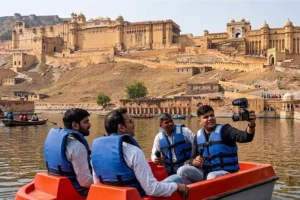
At the foot of Nahargarh Hills by Amer Fort, Sagar Lake is a 16th-century artificial wonder spanning 300 acres. Maharaja Man Singh I kicked it off in 1596; his descendant Man Singh II amped it up in the 18th century with a Darbhawati River dam for irrigation. Today, it's a chill picnic spot with killer Nahargarh views, boating, and migratory birds in winter.
No crowds, just nature's calm. Paddle out, snap fort reflections, or just lounge—feels worlds away from Jaipur's hustle.
Patrika Gate: Jaipur's Instagram-Famous Ninth Gate
At Jawahar Circle, this modern marvel mimics ancient Rajasthani gates with vibrant murals of forts, palaces, weddings, and daily life. Every panel tells a Pink City story—temples, battles, royalty. Built recently but styled old-school, it's free, photogenic, and always buzzing with locals.
Dawn or dusk equals no shadows, perfect pics. It's culture in color, proving Jaipur's heritage lives on.
Sisodia Rani Ka Bagh: A Romantic Mughal Garden Escape
10km on the Jaipur-Agra road, Maharaja Sawai Jai Singh built this charbagh for his second queen. Tiered palaces, fountains, murals of Krishna-Radha tales, and lush lawns make it a love story in stone. Frescoes, pavilions, shrines—it's peak romance.
Wander the levels, decode paintings, breathe easy. Monsoon turns it emerald; couples flock here.
Elephant Village: Ethical Animal Fun Near Amber
In Aravalli foothills by Amber, this village houses fort elephants and mahavats ethically. Started by Rajasthan tourism, it's feeding sessions, rides (short ones), paintings, and cultural shows. Monkeys, birds, greenery—animal lovers' heaven.
- Do: Ethical interactions only.
- Avoid: Long rides; opt for walks.
- Bonus: Traditional dances at dusk.
Bhangarh Fort: India's Most Haunted Ruin
80km out, but worth it—Bhangarh, built by Raja Madho Singh in the 17th century, is eerie beauty. Havelis, temples, markets in ruins amid greenery. Curse legends (wizard love gone wrong) mean no entry after sunset. Daytime exploring feels adventurous; ghosts or not, the vibe's intense.
Climb ruins, picnic safely, chase myths. Pair with Ajabgarh for full spooky day.
Masala Chowk: Street Food Heaven in Open Air
Jaipur's foodie HQ—dhal baati, pyaaz kachori, falooda, all under stars. Vendors from across town serve authentic bites. Live music, fairy lights, family vibes. Go hungry; leave stuffed.
Amar Jawan Jyoti: Tribute to Fallen Heroes
Near Ram Bagh, this India Gate-like memorial honors 1971 war martyrs. Eternal flames, rifle pedestal, black marble. Quiet reflection spot amid city buzz.
Bagru Village: Living Block Printing Art
30km away, Bagru's Chiapas caste hand-prints cotton with wooden blocks and natural dyes. Dabu mud-resist technique creates intricate patterns exported worldwide. Visit studios, see process, buy direct—support artisans.
- Techniques: Mordants, resists, multi-dye dips.
- Shop: Saris, dupattas at factory prices.
- History: 4,500-year-old craft pinnacle here.
Raj Mandir Cinema: Regal Movie Magic
Asia's grandest theatre on Bhagwan Das Road. Chandliers, star ceilings, nine-star facade for Golcha gems. Bollywood in palace style—book front row for immersion.
Quick Comparison: Jaipur's Hidden Gems at a Glance
| Spot | Type | Distance from Jaipur Center | Best For | Crowd Level |
|---|---|---|---|---|
| Garh Ganesh | Temple | 15km | Views & Spirituality | Low |
| Chulgiri | Jain Temple | 12km | Climb & Peace | Low |
| Monkey Temple | Temple Complex | 10km | Monkeys & Springs | Medium |
| Panna Meena | Stepwell | 8km | Photos & Architecture | Low-Medium |
| Bhangarh | Fort | 80km | Adventure & Myths | Medium |
| Masala Chowk | Food Street | City Center | Street Eats | High Nights |
Planning Your Offbeat Jaipur Itinerary
With so many spots, here's a 3-day plan. Day 1: Amer loop—Panna Meena, Sagar Lake, Jagat Shiromani, Elephant Village. Day 2: Hills day—Garh Ganesh, Chulgiri, Monkey Temple. Day 3: Culture dip—Patrika Gate, Bagru, Masala Chowk, Raj Mandir. Rent a cab (₹3000-4000/day), start early, hydrate. Monsoon? Lush green bonus. Winter? Perfect weather.
Budget: ₹2000-3000/person/day incl. food/transport. Stay in Bani Park for access. Apps like RedBus for village trips.
Pro Tips for Hidden Jaipur Explorers
- Carry water, hats—hills bake.
- Respect monkeys/temples—no feeding trash.
- Best season: Oct-Mar.
- Guides: Local uncles cheaper than apps.
- Sustainable: Support Bagru artisans, skip plastic.
These spots aren't just sightseeing—they're soul-stirring. Jaipur's mainstream is cool, but these offbeats reveal the heart. Been? Share below! Safe travels, Jaipur lover.
FAQ
Are these places safe for solo female travelers?
Absolutely, especially daytime. Stick to groups at Bhangarh post-4pm. Locals friendly; use Ola/Uber.
Which is the most photogenic hidden gem?
Panna Meena or Patrika Gate—endless angles, no filters needed.
Can I visit all in one day?
Nope, cluster by area. 3-4 days ideal for depth.
Entry fees for these spots?
Mostly free; Bhangarh ₹20-50, Elephant Village ₹100+ activities.
Best time for festivals here?
Diwali for Garh Ganesh, May for Chulgiri, Sankranti for Monkey Temple.